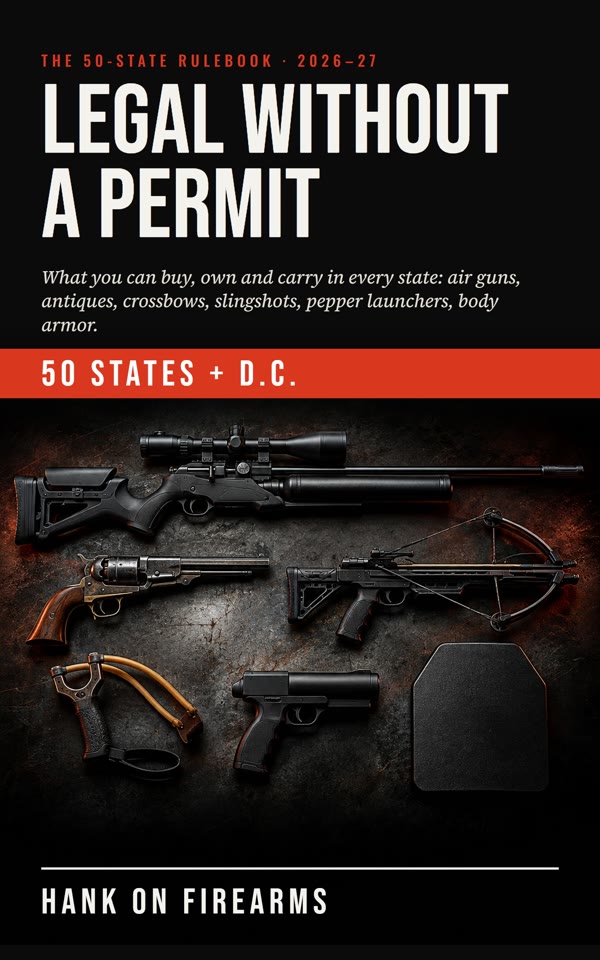
 Legal Without a PermitGet it · $27Legal Without a PermitGet it · $27
Air guns, antiques and muzzleloaders, crossbows, slingshots, pepper launchers and body armor: what you can buy, own and carry in every state, with the law quoted and dated.
Before you click “buy” on a Byrna, a big-bore air rifle or an 1890s Mauser, look up in two minutes whether it’s legal where you live, and why.
$27Get the book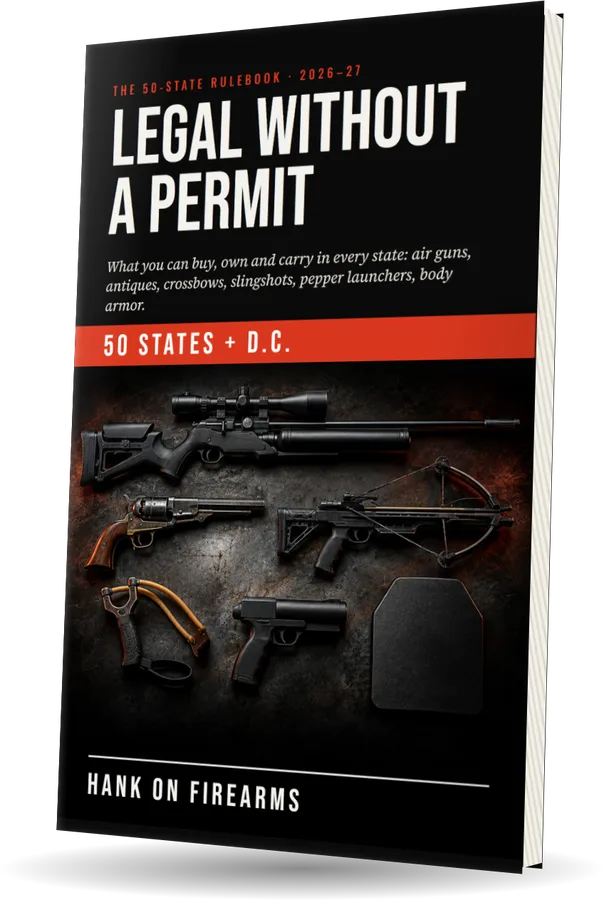
Every video about a pepper-ball launcher, a .45 air rifle or a pre-1899 revolver ends the same way: check your local laws. Then you search, and the answers come from pages that contradict each other, quote no statute and carry no date. One state treats a BB gun as a firearm. Another draws a line by caliber and speed. A third bans a slingshot with a wrist brace. Some let a person with an old felony own a muzzleloader; others make it a crime.
This book does the looking up for you. For each of six categories, in every state and D.C., it tells you whether you can own it, the minimum age, whether you need a permit, whether it can ship to your door, and where you can’t carry it. Each line names the statute and the date we checked it, so you can read the law yourself.
How a state page reads, what the six categories cover, what “checked” means, and what the book can’t do for you.
The federal baseline in plain English: why federal law asks “does it burn powder, and when was it made?” instead of “how hard does it hit?” The firearm definition in 18 U.S.C. 921, the 1898 antique line, muzzleloaders, why air guns sit outside it, the body-armor rule, shipping by mail and carrier, and the federal places you can’t carry.
What counts in each one, with the questions states ask and the traps: BB guns vs pellet guns vs big-bore PCPs and airbows; pre-1899 cartridge guns vs replicas vs inline muzzleloaders; crossbows; wrist-braced slingshots; pepper-ball and kinetic launchers vs pepper spray; soft and hard armor.
The states that break the pattern: where a BB gun is a firearm (New Jersey), Illinois’ caliber-and-velocity line, the city rules of New York City, D.C. and Chicago, slingshot and wrist-brace bans, body-armor limits, and the states that treat antiques as firearms.
The federal prohibited-person rules, why federal law leaves antiques and air guns out and why many states don’t, body armor and violent felonies, a 51-row table of what each state’s law bars, and the lawful roads back: pardon, expungement or set-aside, restoration statutes and federal relief. Compliance only.
The “before you buy” checklist and the “crossing a state line” checklist as full pages, the federal safe-passage rule (18 U.S.C. 926A, what it covers and what it doesn’t), and a fill-in “My State Card” worksheet.
A map to find your state, then two pages per state, each with a red thumb tab:
The terms in plain words; each state’s official code site and how to check a statute yourself in five minutes; the dated changelog of this edition; and the sources behind every page.
A PDF of 264 pages, about 65,000 words, set as a 6 × 9 in book. There is no printed copy.
You pay through Gumroad’s checkout on this page. Gumroad shows the download link right away and emails it to you. If you lose it, the book stays in your Gumroad library.
The videos show the gear. They can’t tell you whether it’s legal in your state. The book does, for all 50 states and D.C., with the statute for each line and the date we checked it, plus the records rules and two checklists.
Every state page and chapter was checked against the statutes in October 2026, and each line shows its date. Laws change, so you also get one free updated edition within a year of buying. The changelog page lists what changed.
No. It’s general information about U.S. federal and state law as written on the dates shown. Cities and counties can add rules of their own. Before you buy, carry, ship or travel, read the current statute and ask a lawyer licensed in your state, above all if you have a criminal record.
Only where they set the line, as in the federal definition of a firearm. The book is about the six categories you can usually buy without a permit, and the places where you can’t.
You can read the PDF in the Kindle app on a phone, tablet or computer. On a small e-ink Kindle the pages show small, because the book is laid out as a 6 × 9 in page.
The 50-State Rulebook. 264 pages, every line with its statute and date.
$27 Get the book